

Streamlining Sustainability Reporting for Land Managers
CeRDI is leading the Food Agility CRC project Streamlining Sustainability Reporting for Land Managers, in collaboration with the Corangamite Catchment Management Authority, Precision Agriculture Pty Ltd and Southern Farming Systems. The project is developing an environmental data integration platform that brings together environmental information from multiple sources and transforms it into decision-ready information for natural capital accounting, sustainability reporting and improved land management. The project demonstrates how common digital infrastructure can help organisations create greater value from environmental data, reduce data collection and reporting burdens and support a wide range of environmental reporting and decision-making needs.
Background
Land managers face increasing expectations to demonstrate their commitment to sustainable land management. Governments, Catchment Management Authorities, agricultural lenders, investors, supply chains and communities all require evidence of environmental performance, often based on different reporting frameworks and information needs. At the same time, environmental information is increasingly being recognised as a valuable asset that has the potential to support better decision-making, demonstrate environmental stewardship and help unlock new sources of investment and market value.
Historically, bespoke solutions have been developed to meet individual reporting and environmental information needs. This leads to duplication of effort and an ever-increasing reporting burden on land managers. This project aimed to demonstrate how a common environmental data integration architecture can streamline reporting processes and support multiple users and reporting frameworks through a single, modular platform.
Outcomes
The project has successfully demonstrated how a single environmental data integration platform can support multiple reporting frameworks and user needs, ranging from farm-scale sustainability reporting to catchment-scale natural capital accounting.
This includes generating ecosystem extent and condition accounts aligned with the System of Environmental-Economic Accounting (SEEA) international standard, as well as other outputs aligned with sustainability reporting standards such as the Taskforce on Nature-related Financial Disclosures (TNFD).
Environmental data should be an asset that adds value, not a reporting burden. There is strong appetite from land managers to engage if systems can reduce duplication and streamline reporting. The project has successfully demonstrated how interoperable environmental data pipelines can reduce duplication, lower reporting costs and make sustainability reporting more efficient and practical.” - Francisco Ascui, CeRDI
Innovation
The project moves beyond individual reporting tools by focusing on the generic, modular digital infrastructure required to support diverse environmental reporting needs. Rather than creating bespoke solutions for each framework or organisation, the project demonstrates how common data pipelines, standardised analytics and interoperable platform architecture can be reused across multiple reporting frameworks and applications.
The future of sustainability reporting is not more data collection. It is better ways of connecting, integrating and reusing existing information. This project provides a practical demonstration of how that future could look.” -Richard Archer, CeRDI
Technical Features
The platform includes:
- Automated ingestion of different types of environmental data from multiple sources
- Metadata harvesting and management
- Data transformation and interoperability workflows
- Spatial analysis and geospatial processing tools
- User-defined area-of-interest selection
- Map-based visualisation tools
- Automated generation of natural capital accounts (e.g. ecosystem extent and condition) and sustainability reporting outputs (e.g. riparian vegetation cover)
- Application Programming Interface (API) architecture to support future integration with other systems.
A design goal of the platform has been to accommodate a wide variety of environmental datasets and reporting requirements with minimal additional development.
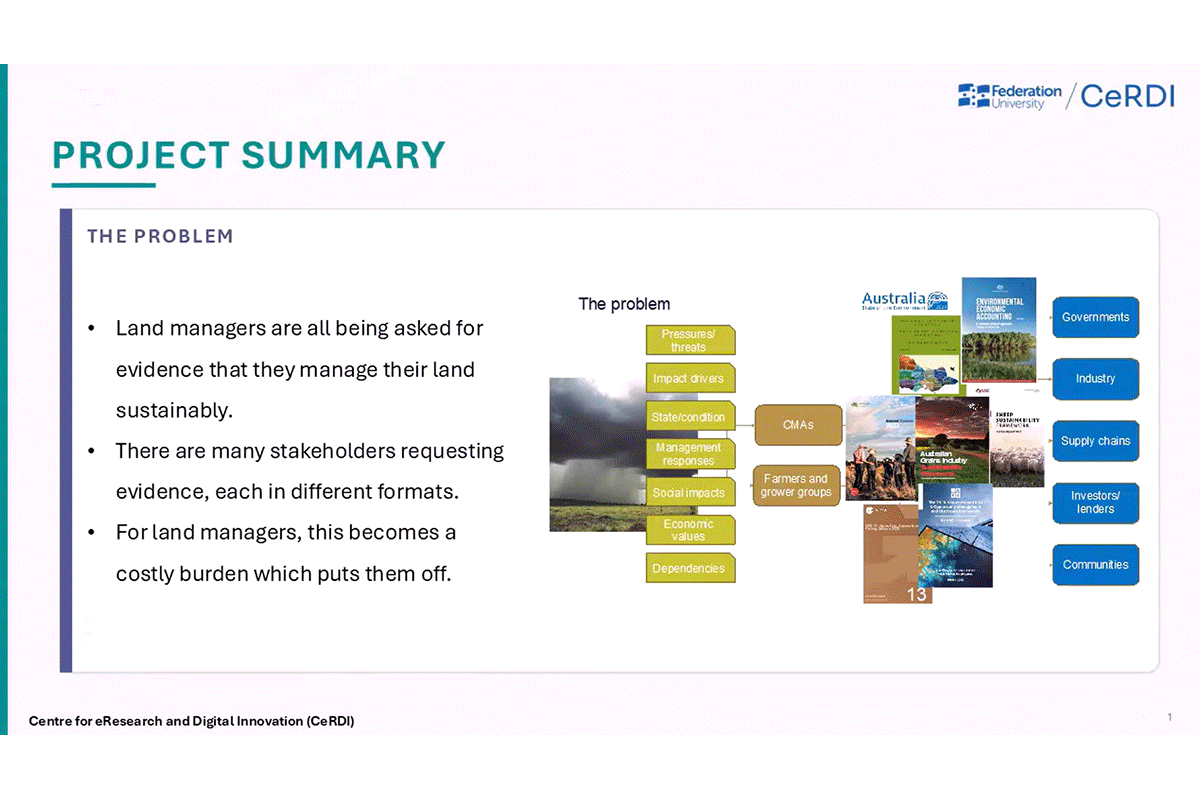 |
Video: Streamlining Sustainability Reporting for Land Managers (7:06)The problem will be familiar. Farmers, catchment management authorities, and other land managers are increasingly asked to prove they manage their land sustainably. These requests come from; Governments, lenders, supply chains, and investors. Producing the evidence in the required format is complex. So many people give up. And opportunities are missed. Our solution is a platform that does the analysis automatically. |
Approach
The project combines expertise in natural capital accounting, environmental science, data engineering and digital innovation. Research activities included:
- Identification of environmental reporting use cases
- Review of sustainability frameworks, indicators and metrics
- Environmental data audit and data source identification
- Development of a conceptual information architecture
- Construction of environmental data ingestion and processing pipelines
- Development of analytical modules and reporting functionality
- Stakeholder co-design and testing.
An iterative development methodology was adopted, enabling functionality to be tested and refined with stakeholders before further development.
Future Directions
The project has demonstrated the feasibility of using shared digital infrastructure to streamline environmental reporting across multiple users, datasets and reporting frameworks. Future work could build on these foundations in several ways.
A key opportunity is to expand the platform’s ability to integrate both public and private environmental datasets, enabling richer reporting and analysis across farm, catchment, regional and national scales. This includes linking producer-generated information with authoritative environmental datasets to improve the accuracy, relevance and utility of sustainability reporting. The concepts and architecture developed through the project could also be applied beyond agriculture, supporting broader environmental reporting and natural capital initiatives.
The project also highlights the potential for developing standardised, reusable environmental data pipelines that can support a wide range of applications, including natural capital accounting, sustainability reporting, environmental benchmarking, supply chain assurance and nature-related financial disclosure. By reducing duplication and improving interoperability, such approaches could substantially lower the cost of environmental reporting while improving consistency and transparency.
Future research could focus on developing additional robust environmental indicators and benchmarks. The ability to transform raw environmental data into trusted, decision-ready indicators was consistently identified as a critical requirement for both land managers and reporting organisations.
The broader challenge remains the development of digital public infrastructure capable of supporting multiple reporting frameworks from common underlying data assets. As expectations around sustainability, nature-related disclosure and environmental stewardship continue to evolve, interoperable systems that allow data to be collected once and reused many times are likely to become increasingly important.

TEAM MEMBERS
Professor Environmental Accounting: Prof Francisco Ascui
Centre Director: Distinguished Professor Helen Thompson
Research Fellow - Data Interoperability: Dr Christiane Bahlo
Research Fellow: Dr Benedikt Fest
Program Manager: Dr Ross Mann
Program Delivery Manager: Richard Archer
Senior Systems Analyst Programmer: Michael Brown
Senior Systems Analyst Programmer: Indika Sirimanna
Manager Technical Projects: Andrew MacLeod



NEWS
Helping land managers demonstrate their environmental credentials, Federation University Australia
 - 7 April 2025
Streamlining sustainability reporting for land managers - CeRDI newsletter, Winter 2025
Land managers face ever-increasing numbers of requests to demonstrate that their land is being managed sustainably... Continue reading...
Sustainability and Natural Capital Reporting Workshop - CeRDI newsletter, Autumn 2026
On 22 April, CeRDI held an online event bringing together researchers, farmers, catchment managers, industry representatives, and advisers.... Continue reading...