


Ecology and migration studies of Latham's Snipe
The Latham's Snipe project was initiated to better understand the ecology and habitat use of Latham's snipe (Gallinago hardwickii), a threatened shorebird species that breeds in Japan and Russia, and migrates to Australia for its non-breeding season (August and March).
This project uses counting, via a national monitoring program, and capture-based research to understand patterns in distribution and abundance, and movement and migration of Latham’s Snipe within the East Asian-Australasian Flyway.
The Latham's Snipe Project is supported by CeRDI, the Australia Government RERI program and the ACT Government.
 |
Background
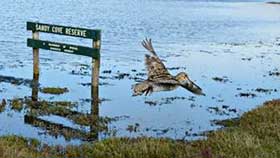 | |
Latham’s Snipe in Port Fairy. | |
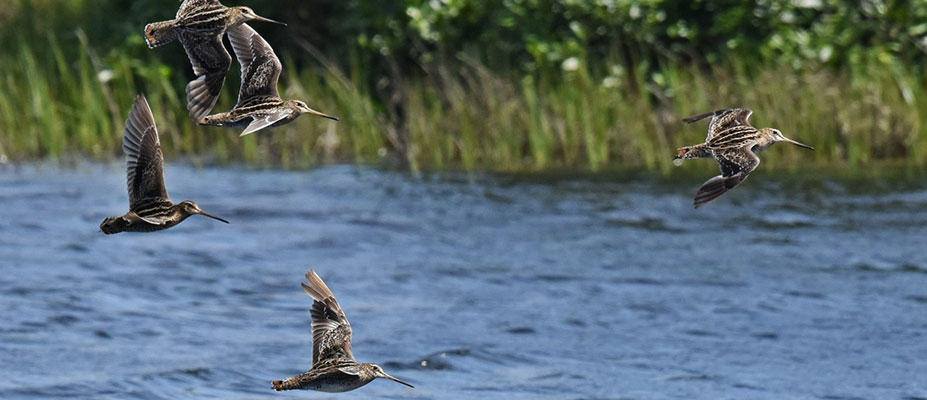
Latham’s Snipe (Gallinago hardwickii) is a medium-sized, cryptic migratory shorebird. The species has a long straight bill used for probing invertebrate food from muddy sediments. Latham’s Snipe is listed as Vulnerable under Federal Government environmental legislation  . Its cryptic appearance (brown mottled plumage) combined with its secretive behaviour makes this species difficult to detect. As a consequence, the species has tended to be overlooked in scientific studies and migratory shorebird monitoring in Australia, leading to many knowledge gaps. The Latham’s Snipe Project was initiated to fill some of these gaps.
This research is being coordinated by Associate Professor Birgita Hansen, Principal Research Fellow in the Centre for eResearch and Digital Innovation (CeRDI). The Latham's Snipe Project is a collaboration between researchers, ornithologists, community groups and decision-makers. The team works collaboratively with colleagues from the Wild Bird Society of Japan (WBSJ) and in eastern Russia. This has enabled the exchange of researchers and research expertise between these countries, facilitating activities associated with the snipe research, and delivering shorebird conservation education to school students. Visits to both Japan and Sakhalin Island (eastern Russia) have provided valuable observations and data for the project, furthering strengthening these collaborations.
The Latham's snipe project was initiated in the wake of a Victorian Civil and Administrative Tribunal case in 2014, regarding a housing development proposal on an important Latham's Snipe wetland (Powling Street wetlands) in Port Fairy, south-west Victoria. During the case, proponents claimed that the housing development would not impact the snipe population because the birds would move to another site. However, there was no evidence to support this claim.
In September 2014, a series of counts was conducted around the Port Fairy and Warrnambool region to determine the relative importance of urban wetlands like the Powling Street wetlands. These counts revealed that over 95% of the population occurred in urban wetlands during the day. Based on this discovery, the count program was extended to the following year to determine if these patterns of wetland use were consistent between years.
Since the 2015-2016 season, the survey program has continued and now encompasses nearly 400 sites across six eastern states and territories. These (now) national snipe surveys provide important insights into the distribution and abundance of Latham’s Snipe, particularly in the southern states where the monitoring efforts have been greatest. Large numbers of snipe have been recorded at some sites - often in urban areas - and frequently at sites with no official protection.
The Latham’s Snipe Project national monitoring program has informed the 2025 update of the BirdLife Australia National Habitat Directory . There are 23 sites with at least one record of 80+ snipe. Collectively the two programs have identified 80 sites with one or more records ≥18 snipe. With every monitoring season, new sites are added to this list. Importantly, a count of 18 or more birds at a site meet the criteria for nationally significant habitat under the Environment Protection and Biodiversity Conservation Act 1999.
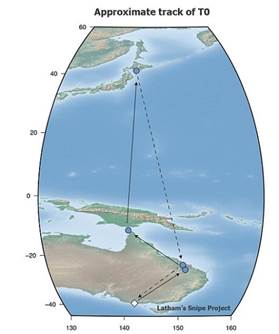
The project also expanded to include a capture and tagging program aimed at investigating snipe migration and movements. Bird monitoring was initially undertaken using data loggers called light-level geolocators, which were deployed on snipe in Port Fairy during spring 2015 and 2016, and then at the Jerrabomberra wetlands in Canberra in summer 2017-2017 and 2017-2018. Recapture of birds is required to retrieve the light data from the logger and reconstruct the migration route. Although 54 devices were deployed, only three were retrieved and only two of these contained full migration tracks. The first device retrieved from snipe T0 yielded a full year of light data, which was analysed to determine the latitude and longitude of the bird over that period.
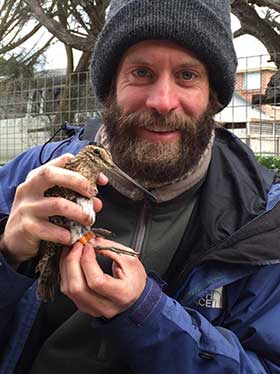 |
Richard Chamberlain with Latham’s |
 |
|
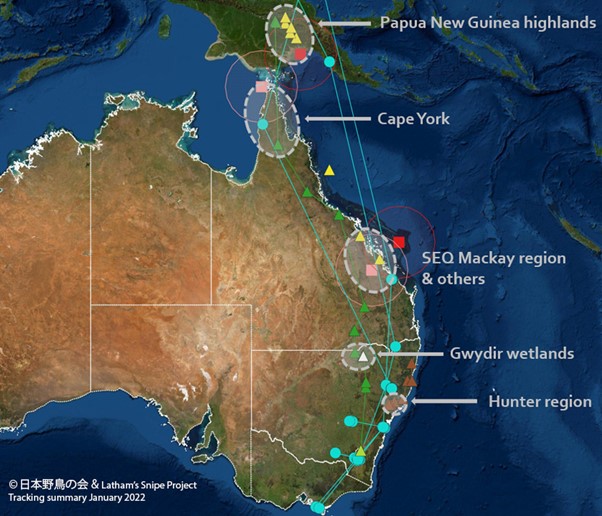
Given the low retrieval rates of geolocators, the Latham’s Snipe project team trialled a range of other tracking technologies including satellite and GPS tracking between 2017 and 2021. In collaboration with the Wild Bird Society of Japan, tracking efforts have yielded an impressive dataset on movement and migration, with 16 partial / full migration tracks obtained using several different technologies (Microwave Telemetry Platform Transmitter Terminals, Lotek PinPoint Argos devices and Druid Bluetooth Nano devices). These have revealed important migration stopover locations in Papua New Guinea, Cape York, the QLD central coast, Gwydir Wetlands the Hunter region and the Lachlan River basin. Analyses of data acquired from Bluetooth Nano devices by PhD student Lori Gould has revealed detailed and highly granular patterns of habitat use and movement in Canberra.
 |
|
Radio tracking was also undertaken in 2016-2018. The radio tracking for snipe at Port Fairy was conducted over two seasons and revealed very distinct partitioning of habitat use by snipe between daytime roost sites and night-time foraging sites. Radio tracking was also trialled in Canberra but was less successful due to transmission interference. Nevertheless, the cumulative insights from both the radio and satellite tracking revealed a common pattern of different habitat use by snipe in the daytime and at night-time.
Research efforts from 2025 onwards are focused on understanding snipe responses to wetland restoration in the Tasmanian Central Plateau, and on addressing knowledge gaps about renewable energy development impacts on Latham’s Snipe.
The Latham’s Snipe Project has been fortunate to have the involvement of student researchers.
Lori Gould (Australian National University) has undertaken an intensive tracking study on Latham’s Snipe in Canberra to investigate movement patterns and habitat use. Lori is due to complete her PhD in 2026.
Saundra Le Clair (a Federation student) is investigating the unique, highland Latham’s Snipe population at Silver Plains in Tasmania. Saundra’s project is in partnership with the Tasmanian Land Conservancy and forms part of a larger wetland restoration program funded by the Ian Potter Foundation .
Honours student Andrew Crossley conducted the radio tracking study in Port Fairy and included sampling of wetland vegetation characteristics at different sites. Andrew found that radio-tacked snipe tended to move between 1-2km from their daytime roosting sites to feed at night in nearby grazed pastures. Andrew’s research complements a report undertaken by Dr Michelle Casanova which comprehensively measured vegetation communities at key Port Fairy sites.
Honours student Michelle Matthews, delved into the history of snipe hunting through interviews with snipe hunters, and how hunting changed with the introduction of the Japan Australia Migratory Bird Agreement in the early 1980s.
Outcomes
Key findings from the Latham’s Snipe project:
- The National Snipe surveys have revealed that large congregations of snipe during daylight hours mostly occur in urban wetlands;
- Sites supporting nationally significant numbers of snipe are rarely protected;
- Snipe roosting occurs during the day usually in thick, scruffy, vegetated wet areas or drier fringing areas adjacent to surface water features. Foraging usually occurs after dark in more open, muddy or irrigated areas that have soft soil / mud where snipe can probe for food.
- Foraging and roosting areas can be in the same location or they may be geographically distinct (up to 6km apart in urban landscapes);
- Snipe migration occurs as direct flights over the Pacific Ocean between Australia and Japan, with extended stopovers for ‘refuelling’ in the Murray Darling Basin, northern NSW, south-eastern and central Queensland, Cape York, and Papua New Guinea;
- Migration paths are greatly variable and collectively encompass almost the entire eastern Australian distribution of the species;
- Some snipe are highly ‘site faithful,’ whilst others may transit through an area on their way to other non-breeding locations in southern Australia.
The Latham's Snipe project is supported by many dedicated counters and volunteers. As the project continues to acquire new knowledge about the species, the people participating in counts and catches has grown. There is now an extended network of volunteers across eastern Australia contributing to the monitoring of snipe, many with expertise in snipe observation and catching.
The project has also been successful in engaging local communities including school children in the Canberra Young Rangers program. This is an important outcome of the project as it increases engagement with the public about wetland habitat protection for snipe conservation.
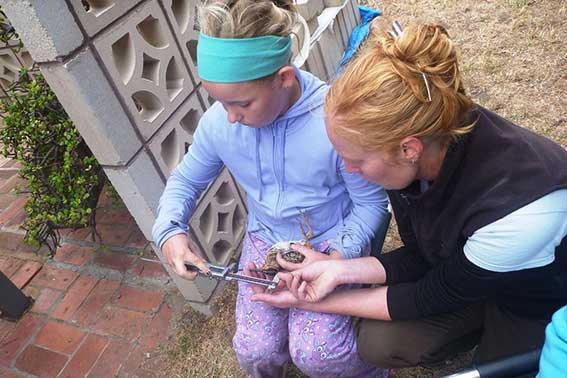 |
Project lead Assoc Prof Birgita Hansen helping Young Ranger Kelly Bateup to measure a snipe. Photo Lori Gould. |
Innovation
The Latham's Snipe project takes an unusual and innovative approach to investigating the migration and habitat use of this species. By building a collaboration with community groups from the outset, the project has established a research and monitoring program that combines traditional scientific approaches with community-based monitoring to answer questions about the species ecology and conservation. This is a rare example of a successful co-designed project.
Approach
The Latham's Snipe project has used several strategies to address its objectives. The most critical of these has been to establish the project as a partnership between academic research and community groups. This has been achieved through a co-design approach that draws upon years of knowledge and expertise gained by community members which is combined with traditional scientific research.
Five complementary methods have been used Latham's Snipe Project to advance knowledge about ecology and migration, and improve conservation outcomes:
- The national survey program focused on longitudinal abundance monitoring at >380 sites across the species’ non-breeding range in eastern Australia;
- Capture-based studies to learn about the ecology, demographics and movement behaviour of four key populations: Port Fairy (VIC), Canberra (ACT), Peterborough (VIC) and Robe (SA). In 2026-2027, this is extending to a fifth major population near Interlaken in TAS;
- Habitat assessments to determine wetland characteristics favoured by snipe;
- Synthesis of scientific and community knowledge to develop best practice guidelines for snipe wetland management and restoration; and
- Social research methods and archival document analysis with process tracing for tracking changes in domestic and international law and policy that affect Latham’s Snipe.
Information from counts conducted by the South Beach Wetlands and Landcare Group formed the basis for designing a survey program that focused on a range of sites where snipe were present and absent. The group's observations over time were critical to determining how to design a capture-based program aimed to deploying geolocators, which require re-capture of the bird and hence, knowledge of the bird's behaviour from year-to-year.
The Latham's Snipe project team visited Hokkaido, Japan in 2016 and 2018, to assist the Wild Bird Society of Japan (WBSJ) with their snipe research. In turn, the WBSJ team visited Canberra in 2017 and 2020. During the second visit they were accompanied by some of the Japanese School children first met in 2017. These reciprocal visits have strengthened ties between the two countries and provided the Australian team with many insights and added information about snipe in Japan. Furthermore, Dr Hansen has visited the island of Sakhalin in eastern Russia (north of Hokkaido) and conducted opportunistic surveys of snipe with Russian colleagues.
The Latham's Snipe project has combined a variety of research and monitoring approaches, including observation, survey, geolocator studies, radio tracking and satellite tracking, to increase our knowledge of the species.
Future Directions
Research for the Latham's Snipe project continued to expand in 2025 via a new partnership with the Tasmanian Land Conservancy. An addition, the Latham’s Snipe Project has become an important contributor to renewable energy planning and this was another focal expansion area in 2025 in partnership with the Arthur Rylah Institute. Wetland restoration work in Tasmania and the Renewable Energy Research Initiative (which has included new field work in Victoria and South Australia) will significantly advance the project’s ability address some major knowledge gaps.
The priorities for future research include:
- Analysis and publication of information obtained from the national surveys, migration tracking, and the social research on hunting and JAMBA;
- Investigation of population responses to highland wetland restoration;
- Further investigation into renewable energy impacts;
- Population trends analysis;
- Understanding the role of cool (cultural) burning in snipe habitat management;
- A review of the conservation and policy status of the world’s snipe and woodcock species;
- An comparative investigation into lowland and highland snipe populations in Australia.
If you are interested in getting involved in the Latham’s Snipe Project, either as a collaborator, a student researcher, or a volunteer, please contact Birgita via email: b.hansen@federation.edu.au
Team Members
The People | Latham's Snipe project
This project has involved a vast number of individuals and organisations. These include: South Beach Wetlands and Landcare Group (Port Fairy), the Wild Bird Society of Japan, The Woodlands and Wetlands Trust (Jerrabomberra Wetlands), the ACT Government, the Victorian State Government Arthur Rylah Institute, the Australian Government Department of Climate Change, Energy, the Environment and Water, The Tasmanian Land Conservancy.

PRESENTATIONS
Hansen B, Honan J, URA T, TAJIRI H, Chamberlain R, Di Stefano J, Bentley J, Fallaw J, Kohlhagen C, Morley C, Stewart D, Gould L. (August 2025) Latham’s Snipe project: Building our knowledge about habitat requirements and movement of Latham’s Snipe. Invited seminar (in-person) for Stone, Springs and Wild Things community forum organised by The Friends of Yatmerone and the Penshurst Volcanoes Discovery Centre, Penshurst town hall.
Hansen B, Honan J, URA T, TAJIRI H, Chamberlain R, Di Stefano J, Bentley J, Fallaw J, Kohlhagen C, Morley C, Stewart D, Gould L. (November 2024) Latham’s Snipe project: Building our knowledge about habitat requirements and movement of Latham’s Snipe. Invited expert presentation to the Wetlands of the West conference, organised by Werribee River Association. Laverton Community Hub.
Hansen B, Tajiri H, Ura T, Honan J, Wilson D, Chamberlain R, Stewart D, McGinness H, Veltheim I, Taws N, Gould L. (October 2022) Latham’s Snipe migration insights 7 years on. Australasian Shorebird Conference, online.
Hansen B, Honan J, Chamberlain, Di Stefano J, Bentley J, Fallaw J, Kohlhagen C, Morley C, Stewart D, Gould L. (August 2022) Nationally important habitat for Latham’s Snipe in Australia. Presentation and panel discussion. International Ornithological Congress (online).
Hansen B, Tajiri H, Ura T, Honan J, Wilson D, Chamberlain R, Stewart D, Veltheim I, Taws N, Gould L. (2020) New evidence of Papua New Guinea as a key staging site for migrating Latham’s Snipe. 1st East Asian-Australasian Flyway Shorebird Science Meeting, Seocheon-gun, Republic of Korea. November 3-5, 2020. Online.
Hansen B, Tajiri H, Ura T, Honan J, Wilson D, Chamberlain R, Stewart D, Veltheim I, Taws N, Gould L. (2020) New evidence of Papua New Guinea as a key staging site for migrating Latham’s Snipe. International Shorebird Twitter Conference, British Ornithological Union, 7-8 October 2020. Online.
Hansen B, Honan J, Wilson D, Stewart D, Crossley A, Chamberlain R, Ura T, Takemae A, Tajiri H, Davey C, Gould L. (2019). An overview of movement and migration knowledge from the Latham’s Snipe Project. Australasian Ornithological Conference, Darwin. 1-5 July 2019.
Hansen B (2019). Satellite transmitter harness design and short-term housing for Latham’s Snipe (poster). Australasian Ornithological Conference, Darwin. 1-5 July 2019.
Hansen B, Wilson D, Honan J, Chamberlain R, Stewart D, Gould L, Crossley A. (2019) Ecology and migration of Latham’s Snipe in Australia. Wild Bird Society of Japan, Tokyo, Japan. April 2019.
Hansen B, Gould L, Davey C, Honan J, Chamberlain R, Stewart D. (2018) The Latham’s Snipe national surveys. Australasian Shorebird Conference, Hobart. 27-28 October 2018.
Hansen B, Wilson D, Honan J, Chamberlain R, Stewart D, Gould L. (2017) Building an understanding of habitat use, movement and migration of Latham’s Snipe. Australasian Ornithology Conference, Geelong. 8-11 November 2017.
Hansen B, Honan J, Stewart D. (2015) What is the relative importance of urban wetlands for Latham’s Snipe in south-west Victoria? Australasian Ornithological Conference. Adelaide. 25-28 November 2015.

RESEARCH OUTPUT
Lindsey, A., Hansen, B. (2026) Latham’s Snipe in the Hunter Region: an overview. The Whistler 20, 1-8. https://www.hboc.org.au/the-whistler-volume-20/
Gould LA, Manning AD, McGinness H, MacKenzie J, Hansen B. (2025) Movement behaviour of migratory Latham’s snipe (Gallinago hardwickii) during their non- breeding season in Australia. Bird Conservation International 35, e34, 1-11. https://doi.org/10.1017/S0959270925100154
Hansen, B.D., Honan, J., Stewart, D., Walters, J., Weston, M.A. (2025) Estimating setback distances for a threatened, cryptic, data-sparse migratory shorebird. PLOS One 20(4): e0317081. https://journals.plos.org/plosone/article?id=10.1371/journal.pone.0317081
Hansen, B., Walters, J., Akers, R. (2025). Guidelines for restoring and managing wetland habitat for Latham’s Snipe. Federation University Australia. Report. https://doi.org/10.25955/28139495.v1
Hansen, B., Ura, T., Tajiri, H. (2022) Insights into migration and distribution of Latham’s Snipe. Tattler 51, 22-24.
Hansen, B. (2021) This bird’s stamina is remarkable: it flies non-stop for 5 days from Japan to Australia, but now its habitat is under threat. The Conversation. 30 Aug 2021 https://theconversation.com/this-birds-stamina-is-remarkable-it-flies-non-stop-for-5-days-from-japan-to-australia-but-now-its-habitat-is-under-threat-165964
Hansen B, Ura T, Tajiri H, Dutson G, Garnett ST (2020) Latham’s Snipe Gallinago hardwickii. In Action Plan for Australian Birds 2020. (Eds ST Garnett and GB Baker) pp. 297-300. CSIRO Publications, Melbourne.
Hansen, B.D., Reviakina, Z., Kulikova, O., Ktitorov, P. (2020) An overview of the Latham’s Snipe population in Sakhalin, Eastern Russia. Stilt 73-74, 52-28.
Hansen B (2020) The Latham’s Snipe Project migration and movement studies. Cumberland Bird Observers Club Inc. Newsletter 42, 1-6.
Hansen B. (2019) The Latham’s Snipe Project migration and movement studies. Queensland Wader 109, 1-3.
Hansen B. (2019) What are we learning from the Latham’s Snipe Project? Geelong Naturalist June 2019, 12-13.
Honan, J. (2018) Collaborative research produces exciting results. Victorian Landcare and Catchment Management 72, 6-7.
Hansen, B. (2017) Site fidelity, migration, movement and habitat preference of Latham’s Snipe: the story so far. Wader Quest Newsletter 4, 12-14.
Wilson, D., Hansen, B., Honan, J. Chamberlain, R. (2017). 170 years of Latham's Snipe Gallinago hardwickii arrivals in New South Wales and the Australian Capital Territory show no change in arrival date. Australian Field Ornithology 34, 76-79.
Hansen, B. (2016). Latham's Snipe tracking project — news brief. Wader Quest Newsletter 3, 17.
Hansen, B., Honan, J., Wilson, D., Chamberlain, R., Stewart, D., Gould, L. (2016). Konnichiwa Ojishigi: following Latham's Snipe from Japan to Australia. Tattler 41, 13-14.
Hansen, B. (2016). Latham's Snipe use of urban versus non-urban wetland habitat in Victoria. Tattler 38, 15.
Hansen, B. (2015). Latham's Snipe count results. Geelong Naturalist 51(8), 9.
Hansen, B., Wilson, D., Koyama, K. (2015). Australian researchers to study Latham's snipe migration. Bird Research Water Bird News. Oct. 2015. Japan Bird Research Association.
Hansen, B., Veltheim, I. (2015). Wetlands, brolgas and Latham's snipe: south-west Victoria's great natural assets. Pp. 57-58 In: Wetlands Australia, National Wetlands Update February 2015 — Issue No 26, Commonwealth of Australia 2015.
Hansen, B. (2015). Latham's Snipe and urban wetlands in the Port Fairy Region. VWSG Bulletin 38, 73-74.

NEWS
Federation in partnership with the Tasmanian Land Conservancy - 24 September 2025
CeRDI’s Dr Birgita Hansen has established a new research program to investigate the ecology and habitat use of Latham’s Snipe... Continue reading...
Showcasing citizen science contributions to the Latham's Snipe - 24 September 2025
Australian citizen scientists have been making important contributions to the conservation of migratory shorebird species, Latham's Snipe... Continue reading...
Advancing the conservation of Latham's Snipe - 13 March 2025
Improving knowledge about the ecology and migration to support conservation of the species.... Continue reading...
Birgita talks Latham's Snipe in Tasmania and Werribee - 17 December 2024
CeRDI Senior Research Fellow Dr Birgita Hansen, leader of the Latham’s Snipe Project, visited Hobart, Tasmania during early November. ... Continue reading...
Latham Snipe research: Documentary and podcast - 9 October 2024
The Latham's Snipe research, led by CeRDI's Dr Birgita Hansen, has been featured in a new documentary film, and an informative podcast... Continue reading...
Tracking the endangered Australian Painted-snipe - 13 December 2022
Research to track of one of the world's rarest and little know birds: the Australian Painted-snipe.... Continue reading...
Latham's snipe project: Successful summer capture - 10 March 2020
During early January 2020 the Latham's Snipe project team braved the heat and smoke of Canberra to catch Latham's Snipe... Continue reading...
Researchers elated by Latham's Snipe recapture - 9 January 2019
Researchers working on the Latham's Snipe migration tracking project make an exciting and significant research advancement.... Continue reading...
Latham’s Snipe research team visit Japan - Winter 2018
A team of researchers, led by CeRDI’s Dr Birgita Hansen, together with school-aged children from the Canberra Young Rangers, recently visited Hokkaido, Japan. Continue reading...
Latham’s snipe research update - Autumn 2017
The Latham’s snipe project commenced in 2015 with the aim of obtaining information on migratory patterns of the Latham’s snipe (Gallinago hardwickii), a shorebird that migrates to the Japan from Australia, and has resulted in the first ever full migration track for the species. Continue reading ..

VIDEOS
SNIPE - The Latham's Snipe Project (24:21)
This is the story of a bird that breeds in Japan and Eastern Russia, and then flies to Australia each year. After spending summer in Australia, it goes back to the Northern Hemisphere and does it all again!
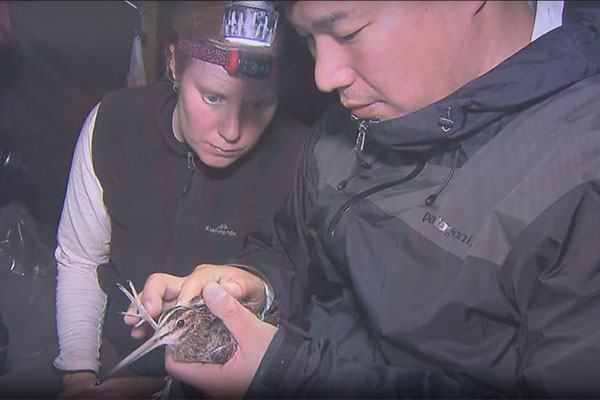
Tracking the Migration of Latham's Snipe (8:56)
Hokkaido Television Broadcasting have produced a short YouTube documentary on their visit to Canberra in January 2017.

PARTNERS
Tasmanian Land Conservancy
The TLC is a not-for-profit, apolitical, science and community-based organisation that raises funds from the public to protect irreplaceable sites and rare ecosystems by buying and managing private land in Tasmania. TLC manages the property Silver Plains, the largest contemporary highland site for snipe.

South Beach Wetlands and Landcare Group
The South Beach Wetlands and Landcare Group is a key partner on the Latham’s Snipe project, providing knowledge, funding through Landcare, field assistance and access to landholder networks.

Victorian Wader Study Group
The Victorian Wader Study Group is a partner to the project through the Group’s long-term scientific program on waders and terns. The Latham’s Snipe project field activities form part of the VWSG’s monitoring program.
Wild Bird Society of Japan
The Wild Bird Society of Japan is a collaborator on the Latham’s Snipe project through contribution to field study, knowledge sharing and reciprocal exchange of researchers.

Woodlands and Wetlands Trust (Jerrabomberra Wetlands)
The Woodlands and Wetlands Trust (Jerrabomberra Wetlands) is a partner on the Latham’s Snipe project through its snipe program in Canberra and provision of funding to support the project.

Australia Japan Foundation
The Australia Japan Foundation is the key funding partner on the Latham’s Snipe project, supporting field-based engagement activities and exchange of Australian and Japanese scientists.